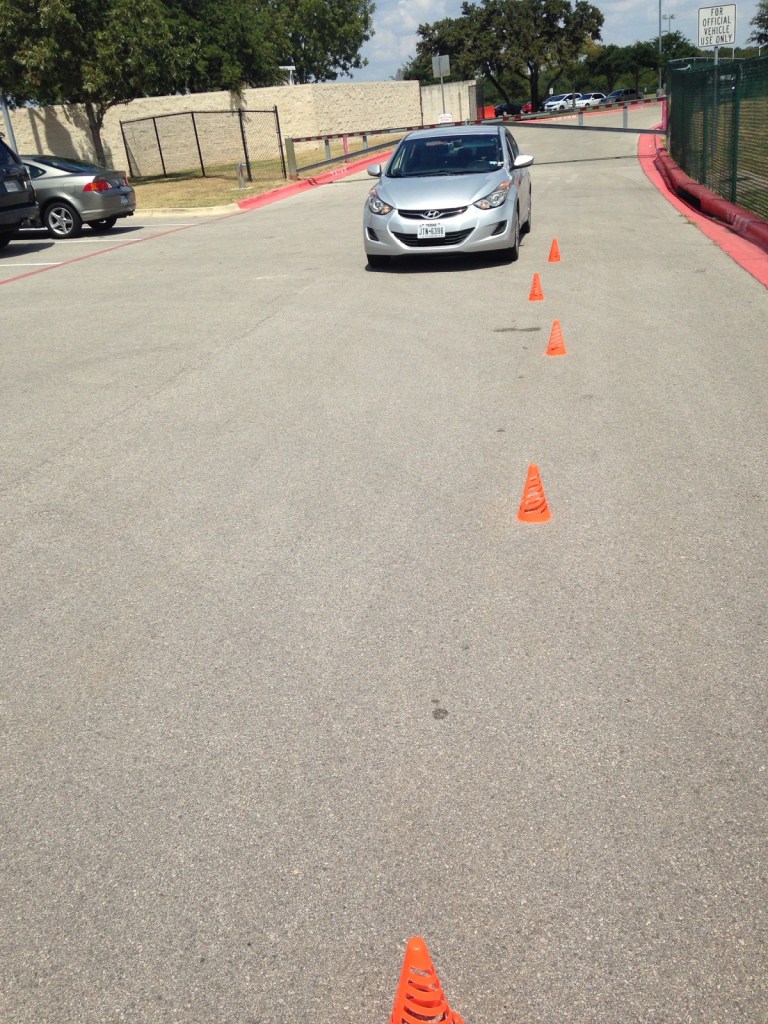
Day 11: “Weigh” my car without picking it up (AP C)

This idea comes from a TED Talk from Frank Noschese. This was day 1 of our Forces Unit in AP Physics C. My goals were for students to learn how to draw detailed Free Body Diagrams and also to think about how to practically apply Newtons’s 2nd Law. The challenge was to “weight my car without picking it up.” I did this as a whole class challenge lab. I described the challenge, introduced the available materials, and answered questions (“no, you may not weigh the car with water displacement”, “yes, I bet that any of you are strong enough to push the car.”) Each team wrote a proposal for how the class would completed this challenge (What will you measure? How will you measure it? How will you use this to determine the mass of the car?). As a class, they shared these proposals and discussed one method to perform as a team. The discussion about friction was awesome! (“Can we just ignore friction?” “What’s the coefficient of friction for your tires, Mr. Randall?” How would we measure friction ourselves?”) After collecting data as a class, each team used the data they collected to calculate the mass of my car. In order to make this less “google-able” I loaded up my truck with textbooks and bowling balls. I plan to take my car to a scale to get it measured precisely before next class.

Day 11: “Speed Dating” as a last-minute review (1yP)

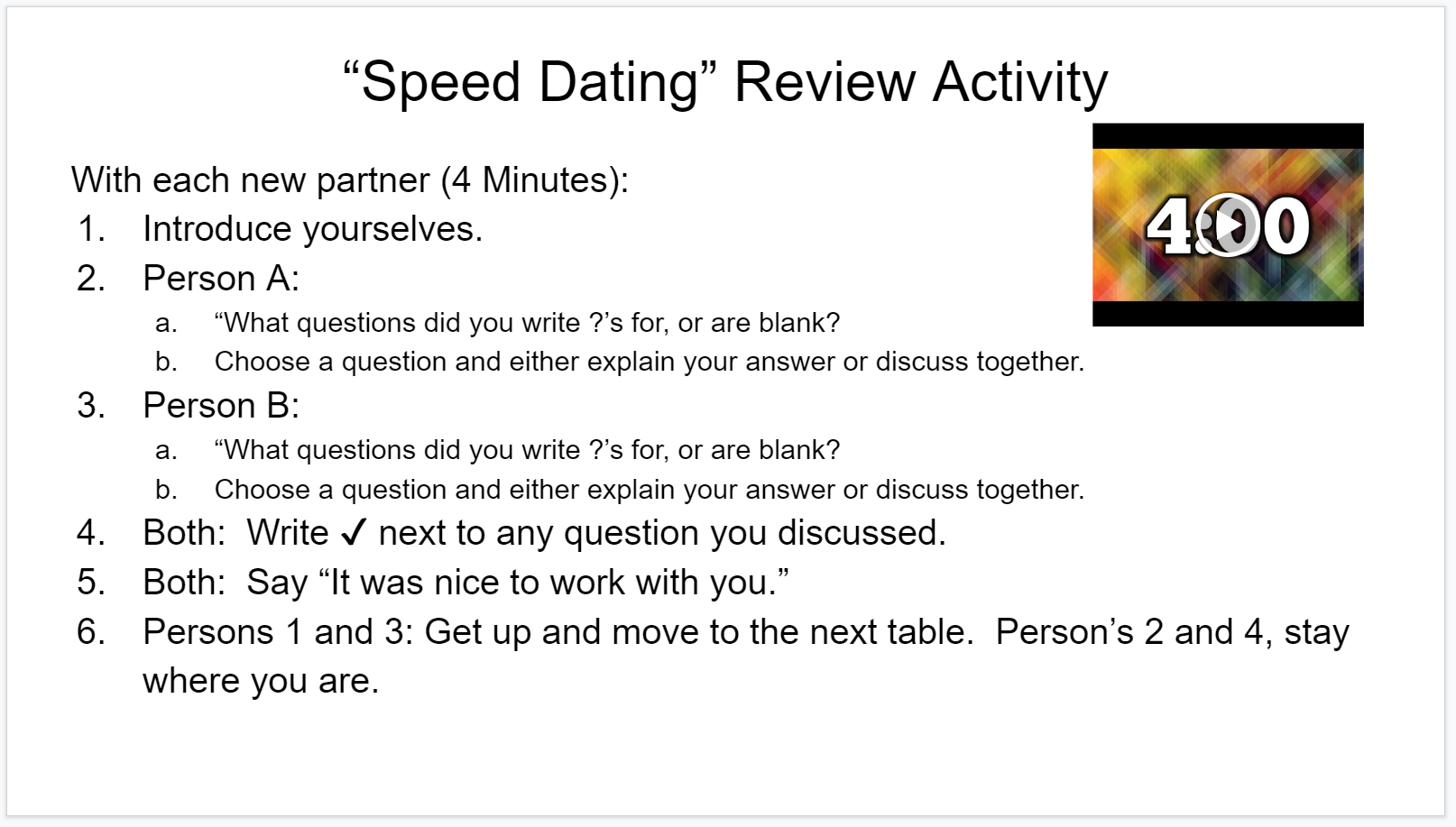
1st year Physics had their second test of the year today. We had about 20 minutes at the start of class for students to review. The most pertinent thing to review was a problem set that students completed for homework. We did this by “speed dating.” Students first spent 5 minutes checking their answers against a key and indicating their level of confidence on each question. Then, we used a rotation system similar to how speed dating works (at least, similar to what I remember seeing in the movie “Hitch”), where students spend 4 minutes talking with students from other lab groups about specific problems from the problem set.

Day 10: Rally Coach with Momentum Conservation (1yP)

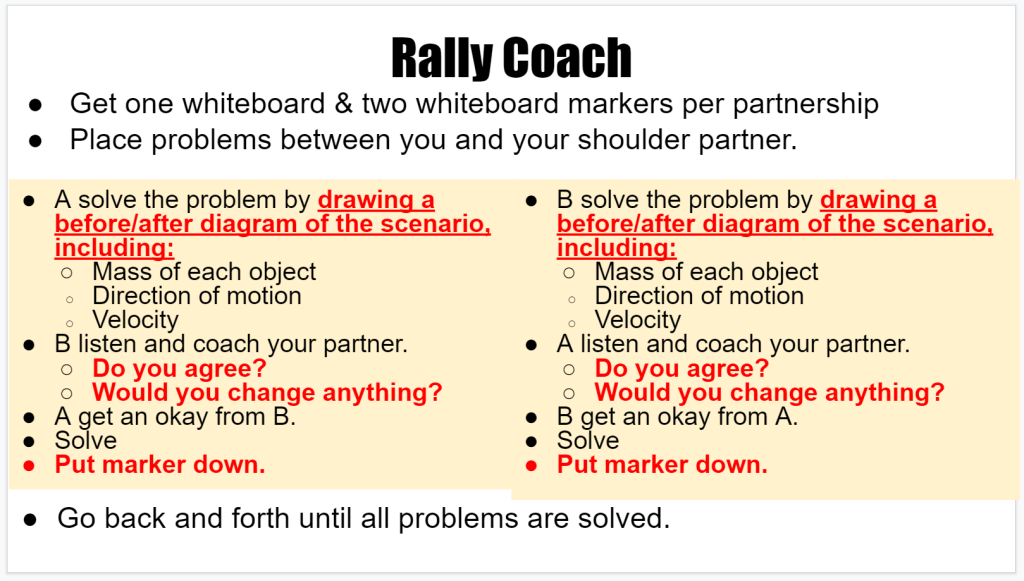
Students were introduced to the concept of the Conservation of Momentum in class today, and then had two different opportunities to practice. The first was a “5 Minute POGIL” with Before/After diagrams and numbers that are easy to figure out in your head. The second activity was more complex. Students worked in pairs to first draw and label a Before/After diagram of a collision from a word problem, and then use this diagram to solve the word problem. Students spent the vast majority of their time talking about physics. This particular task had a good amount of challenge and was definitely “partner worthy.” Students took a picture of the work they completed on the whiteboard. Anything that they completed together would count towards their homework.

Day 9: Multiple Choice Review with Rally Coach (AP C)

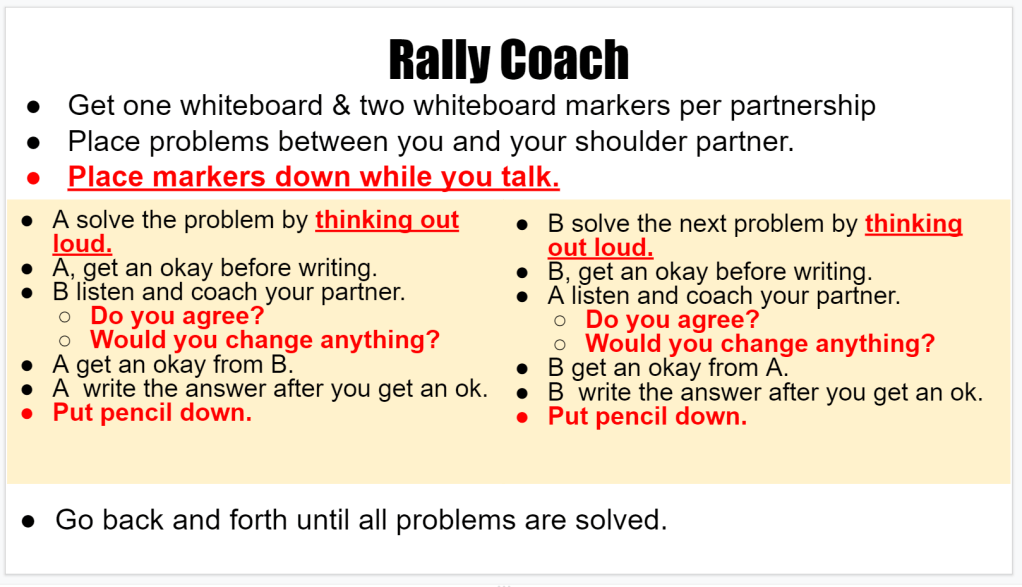
Students worked in pairs to solve multiple choice AP Exam questions to review for our Motion Unit Test. I used the Rally Coach Kagan Structure to encourage discussion among students about the path to take to determine an answer to each problem. I have found that this structure works well when the problem set involves a diverse set of problems/questions where students have a set of equations/processes to choose from to attack a problem.

Day 9: Sharing results from Collisions Lab (1yP)

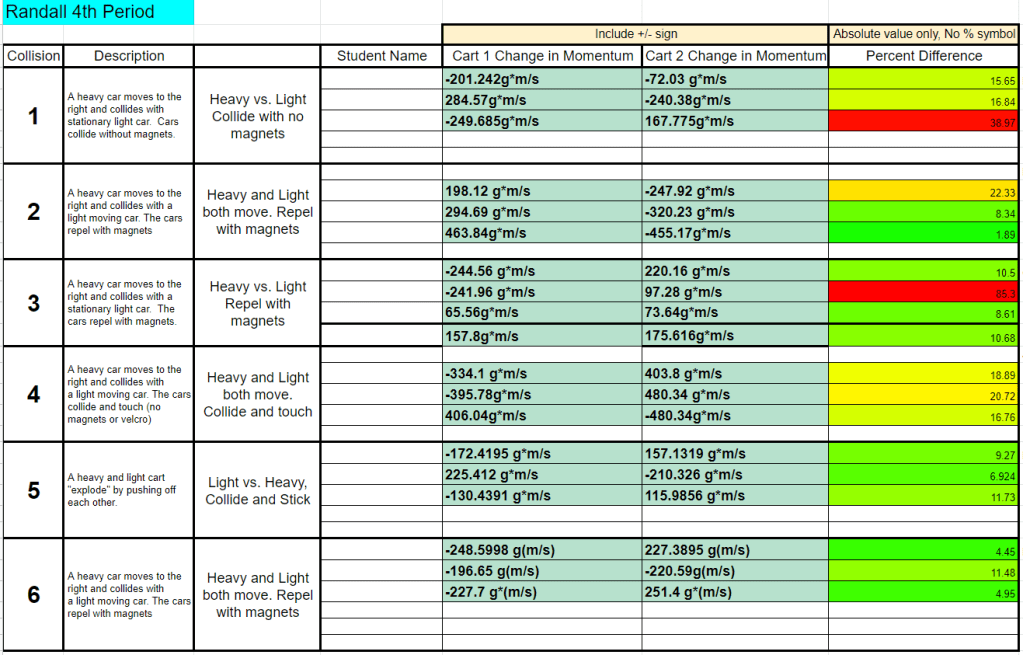
Students in 1st year Physics worked in teams to collect data to determine how the change in momentum for two carts compared in a specific collision. Each group had parameters that made their collision different from others (colliding with or without magnets to make the collision ‘elastic’ or not, varying masses of carts, both cars moving initially or one car stationary, collide and stick or collide and separate, etc…). At students analyzed their own data, they filled out a row in a Google Sheet to share their results. The last column uses conditional formatting to color-code their results (less than 10% percent difference = green, more than 40% difference = red, with color gradient in between). After most students had input their results, we used this spreadsheet to look for patterns.

The main trends: the change in momentum for the two objects generally should have opposite signs, the percent difference between these two changes is generally pretty small, leading to the idea that the changes in momentum for the two objects are equal, but with opposite signs (and further leading to the conservation of momentum).

Day 8: Word Problems without Numbers (AP C)

Students worked to create solutions on a whiteboard to two different “word problems without numbers.” One of my goals of this activity was to show students the variety of methods that they came up with as a class when solving problems. Each problem had two different methods that students figured out how to do, and in some classes there were 4 distinctly different methods of solving one problem.

Day 7: Jot Thoughts and Collisions PreLab (1yP)

Two things to share for today. We are starting a new unit (Momentum). Last year we decided as a district team to move momentum right after constant velocity, instead of waiting for it to the end. The connections with constant velocity, and the simplicity of momentum conservation make it work well as the 2nd unit. I struggled, however, with a story line that I could explain to students. It made sense in my head, but sounded very technical when I tried to tell the story of where we had been and where we were going.

My wife helped me come up with the story line, which is summed up by our Essential Question today, which is “How to objects transfer motion to each other? How can we measure how much motion is transferred?” Describing this in terms of motion makes clear connections to what students have done already. In the coming days, we will discover that it’s not necessarily “motion” that is transferred, but a combination of motion and mass that gets transferred: momentum.

To get students to internalize this and start seeing connections, I started by showing a 1 minute video of “motion” getting transferred, and had students brainstorm, and then later categorize, a list of situations where “motion” is transferred.

Next, students did a pre-lab partner activity to get them to practice analyzing the graphs they will collect in our momentum lab, and to start to think about what factors could cause different outcomes in collisions. Our team had noticed that students had difficulty analyzing these types of graphs in this lab last year. Tony Cacciola had the idea for the pre-lab. Students did a great job discussing and making sense of these graphs, I stationed an “answer key” in the back for them to go check as groups.

Day 7: Drone footage-How constantly can you accelerate? (AP C)

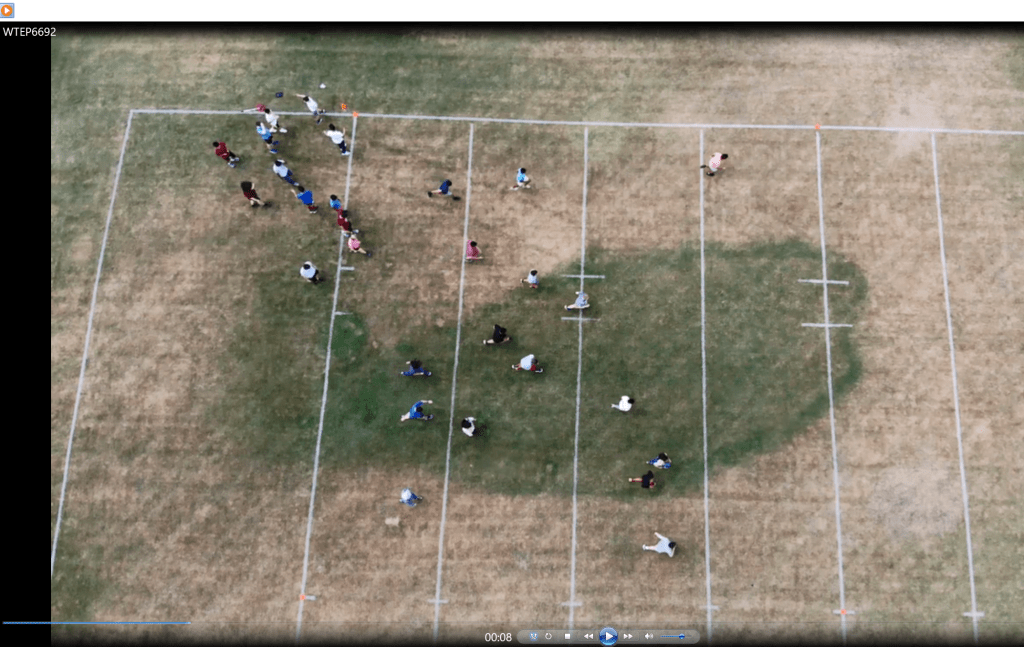
Students in AP C are learning how to linearize data today. We also used a drone to create a top-view video of footage of students running and/or walking on a soccer field with the instructions to “accelerate as constantly as you can over the 20 yard distance.” In today’s lesson, students are following instructions in screencasts that I created to learn how to use LoggerPro or Excel/Sheets to linearize data. Next lesson, students will be doing Video Analysis on this video, and then generating linearized graphs of x vs. t, v vs. t, and v vs. x for the drone video.

Day 6: “Standards-Based” Rubric for Quizzes (AP C)

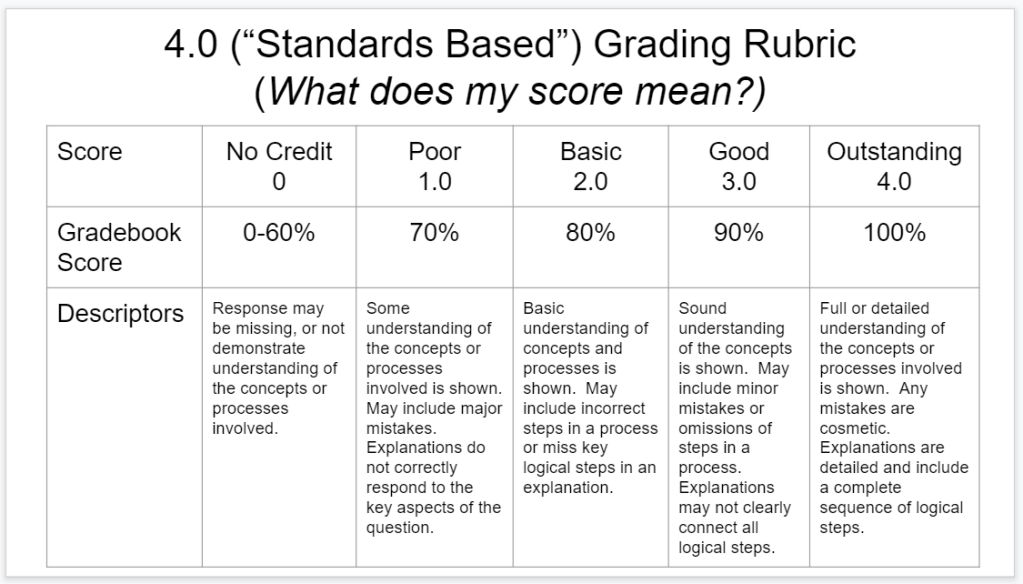
We took our first quiz in AP Physics C last class. Instead of using a point-based system (+1 for step 1, +1 for step 2, +1 for answer with units, etc…), I decided to go back to the 4-3-2-1, standards based grading scale for each question. This quiz involved solving a word problem (most students used algebra), drawing a velocity vs. time graph and using the graph to solve a word problem, and a written explanation supported by evidence. These types of questions lent better to a more holistic grading system rather than adding up individual points. Here’s what I communicated about this system to students:

I teach at a school that doesn’t use standards based grading and where students are in general unfamiliar with things being graded in this way. The science department that I taught with for 10 years previous to this school used a common rubric like this in all levels of science, I think there are a lot of positive aspects in giving students qualities to shoot for in their responses, instead of thinking of points being “taken off” or “added” for specific steps. I wish I could be as brave as Kelly O’Shea with what she has described of her Standards Based Grading. I would also love to figure out how to rewrite this as a rubric phrased with “I can” statements throughout, instead of what students can’t or don’t do. Episode 117 from Jennifer Gonzalez’ Cult of Pedagogy was helpful for me in thinking through how to improve my rubrics. Hopefully, this will be something I am able to do as the year goes on.

Day 6: Stunt Car Challenge Lab (AP C)

Today’s challenge lab in AP C involved launching a hot wheel car from an angle from a tabletop and landing it into a large yogurt container. This is a fun challenge. About half of my groups were successful in landing it right into the container, the other half missed by quite a bit. It’ll be interesting to read through their process to see if there are any commonalities in the ones that missed.