

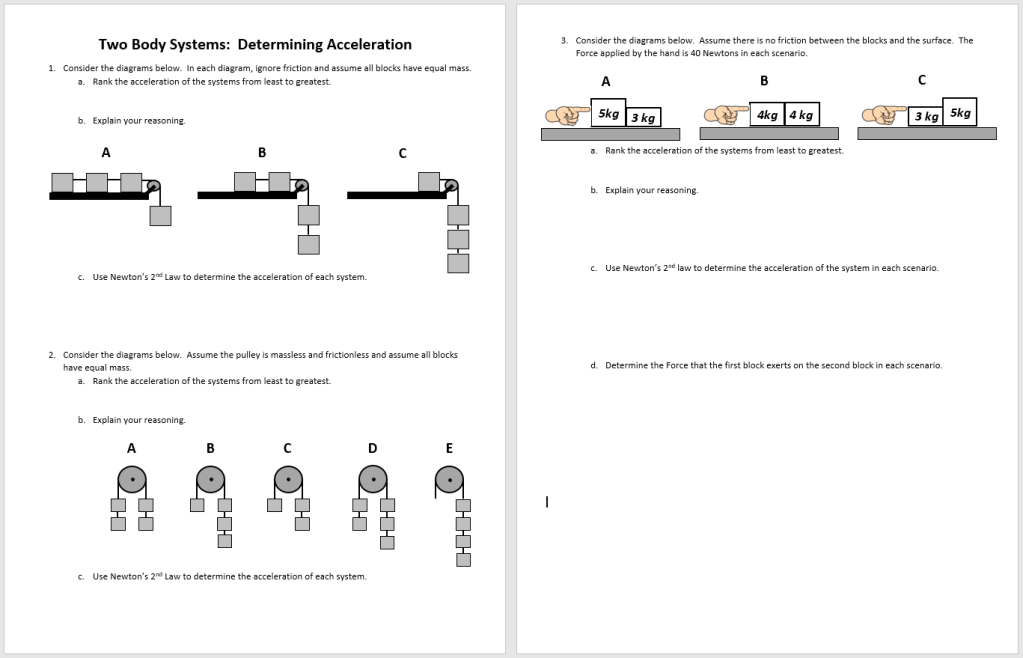
I am really liking the short partner tasks that I have been creating and giving students in AP C. The one for today took students about 15 minutes and helped them consider how to determine acceleration and force for “two body” systems by thinking about the whole system, and not setting up systems of equations (which we did last class). I started doing these last year in our E&M Unit (my first was on determining electric flux) and have been using them on a regular basis (once or twice per week) in AP Physics so far this year. In general, these are based of my experience with Physics by Inquiry, and Tutorials in Introductory Physics. However, instead of being 1 hour lessons, I am tailoring them to be 10-15 minute discussion worthy tasks with a partner.
Here’s the general process: 1) These typically fall after a topic has been introduced, but before students have thought about this particular skill/idea in detail. For example, the one that I had students do to analyze forces on an incline plane came after reading notes that included incline plane examples, and after a lab where students split forces acting at angles into components, but before we had discussed inclined planes in class. 2) Have students “stand up, hand up, pair up” to find a partner not in their current lab group, 3) Each pair of students gets one handout and goes to the lab tables in the back to discusses the prompts/questions on the handout together and writes their responses on the handout, 4) as each pair finishes, they check with another pair of students to check their answers and reasoning, and resolve any differences and then return to their original seats, 5) if the two partners can’t resolve differences, they check with another group, and then with me.
There are a few clear benefits that I’ve seen with this process: 1) Students talk time is at about 50%. Since students are working with a partner and are either sharing their ideas or listening to another students ideas, all of the time. 2) It develops a sense of independence. The more I have done these, the less I am having students come to me to ask if they have “the right answers.” Instead, I am encouraging them to trust themselves. If they apply the rules, processes, and ideas from class and agree with their partner, and then check with another pair of students, they should feel confident in the results. This frees me up to spend more time listening and focusing my time on pairs of students who are having more difficulty with that particular task. 3) There is a specific goal that can be accomplished in a relatively short period of time. Many of the tasks themselves come from longer guided inquiry lessons, which have a place (like the Newton’s 2nd and 3rd Law from my last post), but aren’t necessarily appropriate or desirable for every lesson. The tasks range from 5 minutes to 15 minutes, depending on the task. The movement and change of location plays into this to. Students go to a location to complete a task, and then return to their seats when the task is done.
The two examples below are from today (2 Body systems) and last week (Forces on an incline). I am sharing the original Google Docs of each in case you are interested in trying or modifying them.

The second half of today’s lesson was the 2 Body System Challenge Lab. The challenge had 2 parts: 1) determine the time it will take the cart to travel a 50cm distance up the incline, and 2) determine the tension in the string as the cart accelerates up the incline. This required setting up and solving systems of equations (our goal last class).

 Randall Physics