

Today was an awesome day in 1st year Physics! We started the constant acceleration unit with the ramp lab from the modeling curriculum. In the past, I have done this with the same spinners that I used in the Day 1 Challenge Lab for AP Physics. That was a good lab set-up, but the spinners are so easy to break and tricky to make. This is the same lab, but with the accelerated object as a battery, section of PVC, round weight, or other cylindrical object rolling down a lab table that is made into a ramp by putting something small (I used workbooks for half of the classroom and small chunks of 3/4″ plywood for the other half). Students placed a strip of butcher paper along the length of the table and then marked the position of the object at the beginning of its motion, and then at 1 second time intervals as a metronome at 60 bpm played over the speakers in the classroom. Data was quick and easy for students to collect, and they easily made the connection that this was a real-life “motion diagram,” just like the ones we created in the constant velocity unit. Thanks to Amanda Powell for sharing this idea with me.
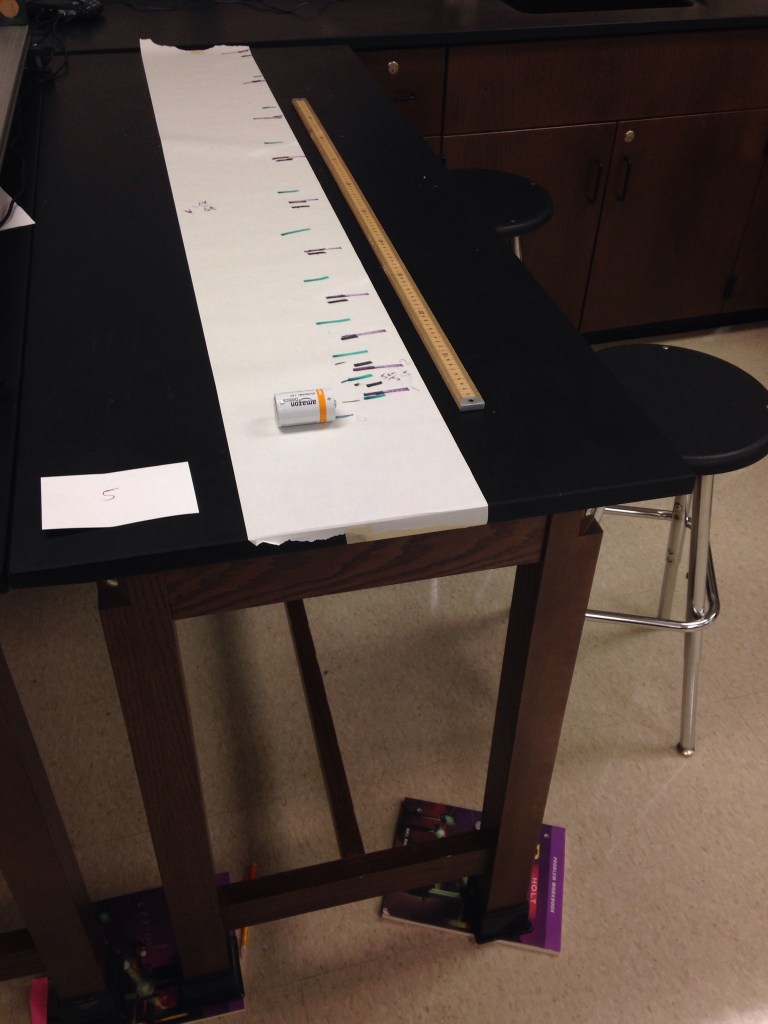
The best part of the lab, however, was the focus and discussion on today’s Essential Question, which was “How can we determine the speed of an object at an instant, even if the speed of the object is changing (not constant)?” After students crated a position vs. time graph, we had prompts to help them think about how to calculate speeds from their data, and to think about at what time that speed actually occurs. I did a Physics by Inquiry “check out” style discussion with each team, before they worked on a worksheet with similar questions that asked them to apply our operational definition of Instantaneous Velocity (finding the average velocity over a time interval where the instant in question is in the middle). Next class the focus will be on the velocity vs. time graphs with a post-lab whiteboard discussion comparing the graphs, equations, and written representations from each team.
 Randall Physics