

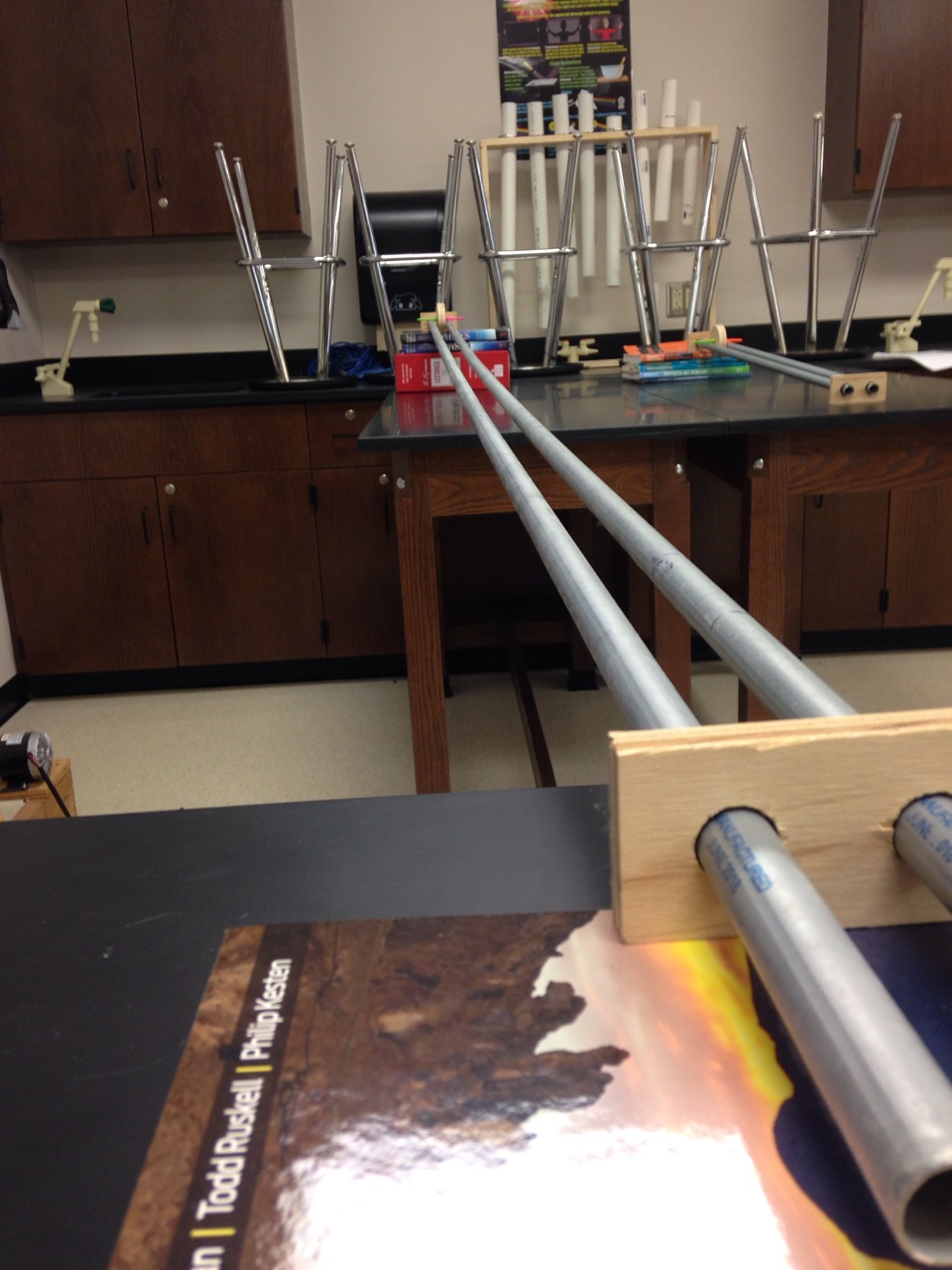
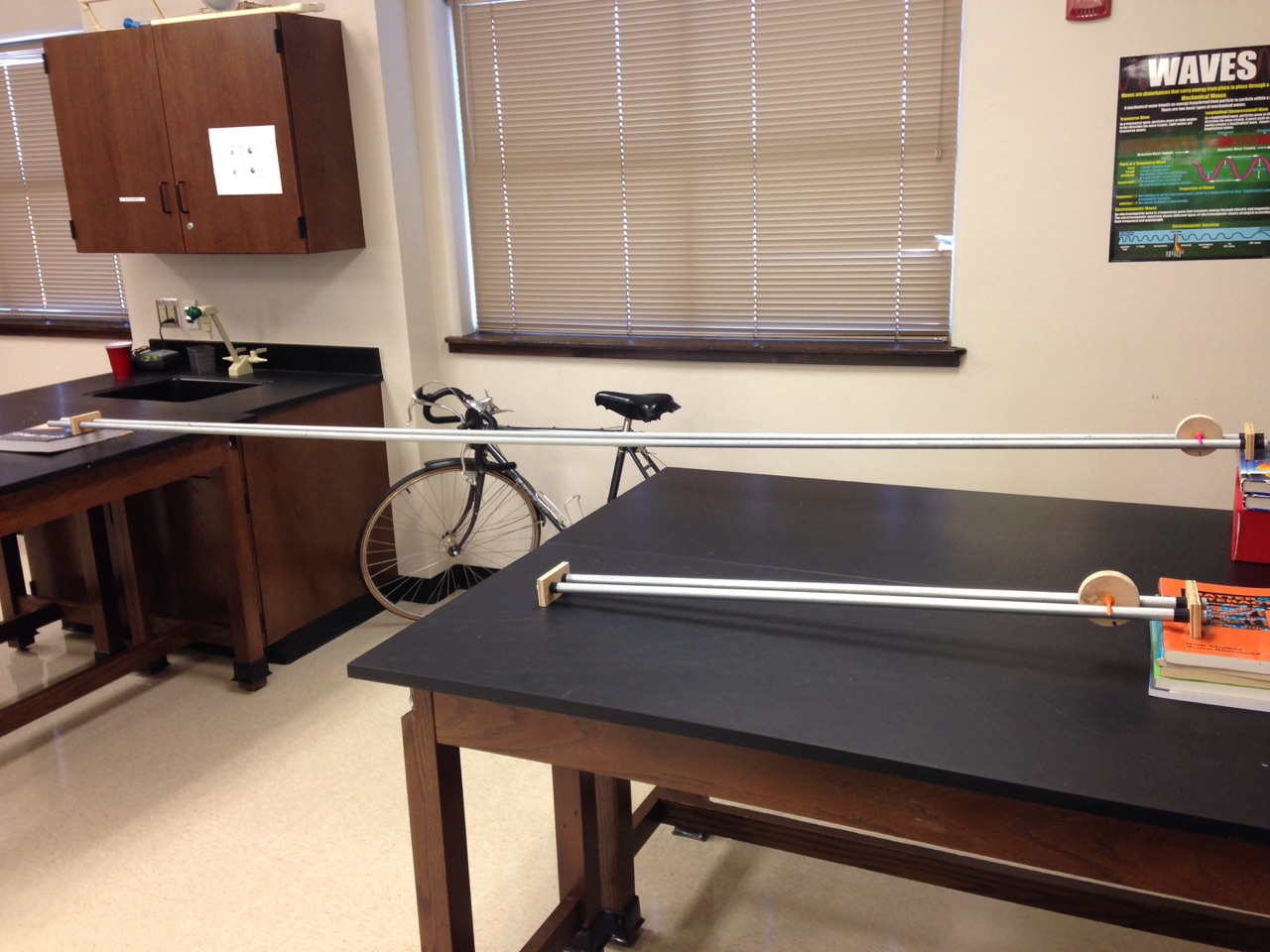
The first day of school will be a challenge lab in AP Physics C. This is based off a version of the constant acceleration paradigm lab with a “spinner” rolling down a ramp. In the challenge lab, students are challenged to predict the time it will take for the spinner to reach the bottom of a large (3 meter long) ramp. To do this, they may set-up and make measurements on smaller (1 meter long) ramps, but may not make any measurements of the motion of the spinner on the big ramp.

 Randall Physics
Hi…have a bunch of questions for you regarding the spinner challenge.
1) Is your AP C course a 1st yr or 2nd yr course?
2) I do challenge labs for my AP C course. It appears in your pics that different groups have different slopes? Does a group use the same angle for the 1 meter and for the 3meter challenge? If the slope changes, they won’t be able to predict the time, right?
3) what materials did you use for the rails? They look little in the pics. What did you use for the spinner?
LikeLike
Hi Doug,
Great questions! AP C is a 2nd year course at my school. We do Mechanics 1st semester and E&M 2nd. When groups did the challenge lab, they were given materials to set up their own smaller version of the track and could decide as a team how to attempt to replicate the angle of the track. In general, I use a small enough angle that the spinner won’t slip, but I change it between class periods. Some groups replicated the angle by using the iPhone Compass App (I show and suggest this as an option), others measure the height and length of the right triangle formed by the ramp and use similar triangles. Trying to match the angle so that they can calculate the acceleration is the key for this challenge lab.
I didn’t intend for this, but the long ramp ends up being a bit “bowed.” I used relatively thin conduit from the hardware store and it ends up bending under its own weight. When students measure the angle of the ramp, they often notice that the angle varies as they go down the ramp (ranging from 6 degrees to 2 degrees, for example). However, the results still end up being quite good. Almost everyone is within 20%, and many within 10%. This leads to a great discussion about what assumptions teams made, why it is helpful or necessary to make assumptions, and how the bow of the ramp affects their results.
The setup for this comes from the modeling curriculum. The materials are made from 1/2″ EMT conduit. The outer diameter of this is just under 3/4″. I made the wooden ends by drilling 3/4″ holes into pieces of plywood that I ripped to 1 3/4″ wide and cut to 4″ long. 4″ sections of 1×2 pine board would work fine too. The spinners are tricky. I used a drill press to cut 5/8″ plywood (1/2″ or 3/4″ would work fine too) into 3″ diameter holes. Golf tees are glued onto the side with wood glue. The trick is to mark the very center of the circle, glue one side at a time, and then explain clearly how fragile these things are. The curve of the golf tee gives this a self-correcting action, kind of like the wheels on a train. I have seen similar designs with wood dowels, CDs, and rubber grommets that are easier to build but don’t “self-correct.”
LikeLike